We're just about finished with our study of economics! We started out by learning the difference between needs and wants. Then, we learned that people buy goods and services in the community. Finally, we looked at how goods are produced, and the process of production from raw material to finished product.
Here are some activities that you can try!
Goods and services interactive
Do you know the difference between goods and services? This interactive helps you to sort them.
Goods and Services
This page explains the difference between goods and services.
How people make things
Old but good! This link takes you to a variety of factory tours.
Extension: Colonial Economy
We've looked at the basics of economic systems. At this site, you can learn about the economy of colonial New York.
History of Money
Learn interesting facts about money with these games from the U.S. Mint.
Monday, October 24, 2011

Saturday, October 15, 2011
Understanding Story Elements
We're working on story elements! Stories all contain some common parts, or elements:
-Characters
-Setting
-Conflict
-Plot
-Theme
Here are some activities that you might like to try.
Cinderella Interactive
This fun interactive helps you to understand story elements.
Create a Story Map
Have a great idea for a story? At this site, from Read Write Think, you will be able to use interactive story mapping tools to create a story map.
Word Girl
From PBS Kids. Watch a short episode online. Can you find the characters? The setting? What is the conflict? How is it solved?
Story Starter
This fun tool from Scholastic lets you create your own story.
-Characters
-Setting
-Conflict
-Plot
-Theme
Here are some activities that you might like to try.
Cinderella Interactive
This fun interactive helps you to understand story elements.
Create a Story Map
Have a great idea for a story? At this site, from Read Write Think, you will be able to use interactive story mapping tools to create a story map.
Word Girl
From PBS Kids. Watch a short episode online. Can you find the characters? The setting? What is the conflict? How is it solved?
Story Starter
This fun tool from Scholastic lets you create your own story.
Friday, September 23, 2011
Learning About Historians
This week, we learned that historians use primary sources such as documents, photographs, and interviews to learn about the past. We had a visit from local historian Deb McCauslin, who played the role of Sarah Cook Myers in a living history performance.
Mrs. McCauslin helped us to understand how historians learn about the past, and shared some of her research with us. If you're interested in reading more about her, you can visit her website:
Gettysburg Histories
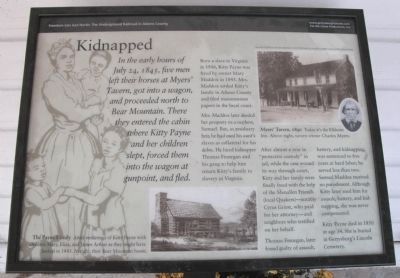
Mrs. McCauslin worked to create a historical marker in Bendersville to commemorate the kidnapping of Kitty Payne. Maybe you can visit the marker and see it for yourself--it's right in front of the Elkhorn Inn.
Students as historians
 Students are going to become historians. They will be working with primary sources in two different ways. Students have a homework assignment to interview someone about their school experiences. Some students have already completed their interviews and have great stories to share! While these interviews may not be as dramatic as the story of Kitty Payne, they are snapshots of real history.
Another way that we can learn about the past is by analyzing photographs. We can look at the people, objects, and activities in a photo. Then we can use what we have noticed by breaking down the photograph to make some inferences, or good guesses, about the photo.
You can try this at home! The National Apple Museum has a wonderful online collection of local photographs:
Old photographs of Adams County
Try looking at these pictures. What do you notice? What people do you see? What objects are in the picture? What activities are they doing? (It's also fun to look at how places that you know have changed. Check out the picture of Bendersville on this page.)
If you find a picture that you especially like, write down your observations to share with the class. It's your chance to be a historian!
Mrs. McCauslin helped us to understand how historians learn about the past, and shared some of her research with us. If you're interested in reading more about her, you can visit her website:
Gettysburg Histories
Mrs. McCauslin worked to create a historical marker in Bendersville to commemorate the kidnapping of Kitty Payne. Maybe you can visit the marker and see it for yourself--it's right in front of the Elkhorn Inn.
Students as historians
Another way that we can learn about the past is by analyzing photographs. We can look at the people, objects, and activities in a photo. Then we can use what we have noticed by breaking down the photograph to make some inferences, or good guesses, about the photo.
You can try this at home! The National Apple Museum has a wonderful online collection of local photographs:
Old photographs of Adams County
Try looking at these pictures. What do you notice? What people do you see? What objects are in the picture? What activities are they doing? (It's also fun to look at how places that you know have changed. Check out the picture of Bendersville on this page.)
If you find a picture that you especially like, write down your observations to share with the class. It's your chance to be a historian!
Sunday, September 11, 2011
Multiple Meaning Words
"The student brought a bat to school."
What do you picture when you read this sentence? Do you imagine a students with a baseball bat? Or do you imagine the flying mammal? Bat is a multiple meaning word. The reader needs to use the context to figure out how bat is being used in the sentence.
"On the day of the softball game, the student brought a bat to school."
Now what kind of bat do you imagine? In this sentence, the context shows you which kind of bat the student probably has. A living bat wouldn't be much use at a softball game, so the bat is probably a baseball bat. As readers, we still need a little more information to figure out which meaning is used. Maybe the next sentence will help:
"On the day of the softball game, the student brought a bat to school. She hoped that her lucky wooden bat would help her to hit a home run."
 Multiple meaning words can be tricky for readers. Some meanings of words, like the two kinds of bats, aren't connected. But others have a distant connection. Think about the palm of your hand. The word palm as in a palm tree is related. Why do you think someone may have used the word palm to describe the tree? Even though the palm of your hand is a different meaning from a palm tree, both meanings share a common origin.
Some multiple meaning words can be used in different ways. Think about a snack. This word can be used as a noun--think about a snack that you eat! But it can also be used as a verb, as in the sentence, "Bob liked to snack on sunflower seeds." These meanings are also closely related.
To learn more about multiple meaning words, check out this slideshow.
What do you picture when you read this sentence? Do you imagine a students with a baseball bat? Or do you imagine the flying mammal? Bat is a multiple meaning word. The reader needs to use the context to figure out how bat is being used in the sentence.
"On the day of the softball game, the student brought a bat to school."
Now what kind of bat do you imagine? In this sentence, the context shows you which kind of bat the student probably has. A living bat wouldn't be much use at a softball game, so the bat is probably a baseball bat. As readers, we still need a little more information to figure out which meaning is used. Maybe the next sentence will help:
"On the day of the softball game, the student brought a bat to school. She hoped that her lucky wooden bat would help her to hit a home run."

Some multiple meaning words can be used in different ways. Think about a snack. This word can be used as a noun--think about a snack that you eat! But it can also be used as a verb, as in the sentence, "Bob liked to snack on sunflower seeds." These meanings are also closely related.
To learn more about multiple meaning words, check out this slideshow.
Friday, September 2, 2011
Hurricane Tracking
Hurricanes are fascinating and very much in the news lately. We've been learning about longitude and latitude by tracking tropical storms on our own maps. By tracking these storms, we're learning how to use the lines of latitude and longitude to find an exact location. We're also learning about how scientists gather and track data.
We've been using the Hurricane Tracker from Weather.com. Here is the link:
http://www.weather.com/weather/hurricanecentral/tracker
This site has great data that is updated frequently. As a class, we enjoyed studying the graphics and figuring out what the different colors mean. How does it show a Category 1 hurricane? How does it show a tropical storm? How is a Category 5 storm represented?
Students have great questions about hurricanes! If you're looking for more information and other activities, you can visit this National Geographic site.
http://www.nationalgeographic.com/xpeditions/activities/07/stormy.html
We were also interested in exploring the names for hurricanes. Here is a list of names for future storms.
http://www.nhc.noaa.gov/aboutnames.shtml
If you're looking for more activities and interactives, you can find other resources at the FEMA website.
http://www.fema.gov/kids/hurr.htm
We've been using the Hurricane Tracker from Weather.com. Here is the link:
http://www.weather.com/weather/hurricanecentral/tracker
This site has great data that is updated frequently. As a class, we enjoyed studying the graphics and figuring out what the different colors mean. How does it show a Category 1 hurricane? How does it show a tropical storm? How is a Category 5 storm represented?
Students have great questions about hurricanes! If you're looking for more information and other activities, you can visit this National Geographic site.
http://www.nationalgeographic.com/xpeditions/activities/07/stormy.html
We were also interested in exploring the names for hurricanes. Here is a list of names for future storms.
http://www.nhc.noaa.gov/aboutnames.shtml
If you're looking for more activities and interactives, you can find other resources at the FEMA website.
http://www.fema.gov/kids/hurr.htm
Friday, August 19, 2011
Learning About Geometry
In fourth grade, our first math unit focuses on geometry. This kind of thinking is very important for students. We'll focus on:
-How are different shapes similar and different?
-How can we identify different shapes?
-How can we use inductive reasoning to solve polygon riddles?
-How do different shapes fit together?
-What are the properties of 3D shapes?
Being able to visualize different shapes, both flat and three-dimensional, has proven to be an important skill for future science and math success. It's exciting to start the school year with such a concrete topic that will help students to build these vital abilities.
Here are some fun resources that you can use to learn more about geometry.
3D Shapes Interactive: This site explores properties of 3D shapes. Look at the "3D Shapes" tab to see an animated sequence showing the vertices and edges of solid shapes.
Quadrilaterals: Learn about the properties of 4-sided polygons. Then, drag the dots to explore how the shapes can change.
Solid Geometry: More with 3D shapes.
Star Gazing: A Cyberchase game that looks at measuring angles.
2D to 3D Morphing: A Cyberchase activity to make 3D shapes out of flat ones. (If you make these, bring them in to share!)
Geometric Shape Flashcards: Use these to practice vocabulary for the unit. (Note: Some of the ideas on the flashcards will not be covered in our unit. Don't worry!)
Hidden Picture: Practice math terms by finding a hidden picture.
Everyday Mathematics Vocabulary: This site, from another school district, has vocabulary sheets for every unit. Download "Unit 1" to see a list of definitions with pictures.
Enjoy learning about geometry!
-How are different shapes similar and different?
-How can we identify different shapes?
-How can we use inductive reasoning to solve polygon riddles?
-How do different shapes fit together?
-What are the properties of 3D shapes?
Being able to visualize different shapes, both flat and three-dimensional, has proven to be an important skill for future science and math success. It's exciting to start the school year with such a concrete topic that will help students to build these vital abilities.
Here are some fun resources that you can use to learn more about geometry.
3D Shapes Interactive: This site explores properties of 3D shapes. Look at the "3D Shapes" tab to see an animated sequence showing the vertices and edges of solid shapes.
Quadrilaterals: Learn about the properties of 4-sided polygons. Then, drag the dots to explore how the shapes can change.
Solid Geometry: More with 3D shapes.
Star Gazing: A Cyberchase game that looks at measuring angles.
2D to 3D Morphing: A Cyberchase activity to make 3D shapes out of flat ones. (If you make these, bring them in to share!)
Geometric Shape Flashcards: Use these to practice vocabulary for the unit. (Note: Some of the ideas on the flashcards will not be covered in our unit. Don't worry!)
Hidden Picture: Practice math terms by finding a hidden picture.
Everyday Mathematics Vocabulary: This site, from another school district, has vocabulary sheets for every unit. Download "Unit 1" to see a list of definitions with pictures.
Enjoy learning about geometry!
Saturday, April 23, 2011
Learning About Rocks and Minerals
In the last few weeks of school, we're going to learn about rocks and minerals! Our exploration will begin by studying cave formations--after all, we'll be visiting Indian Echo Caverns in a few weeks.
Here are some fun cave websites to explore.
Cave formation animation: This site shows how caves form.
How are caves different? This fun site for kids shows differences between life in caves and life above ground.
What in the world is karst? While Adams County is not home to many karst formations, much of Pennsylvania is. Learn about karst with animations and info on this page.
Indian Echo Caverns: Learn more about Indian Echo on this page.
Here are some fun cave websites to explore.
Cave formation animation: This site shows how caves form.
How are caves different? This fun site for kids shows differences between life in caves and life above ground.
What in the world is karst? While Adams County is not home to many karst formations, much of Pennsylvania is. Learn about karst with animations and info on this page.
Indian Echo Caverns: Learn more about Indian Echo on this page.
Subscribe to:
Posts (Atom)